Fuimos al Norte por el fin de semana pasado.
We went North over the weekend- to the provinces Salta and Jujuy (pronounced who-whooey). It was absolutely gorgeous!

It seems EVERY city big or small has a plaza in the center; this is the Plaza 9 de Julio (July 9th marks the date of Argentina's Independence from Spain). Most plazas have a cathedral, cabildo (like a city building), justice building, statue(s)/water fountains, and then restaurants and other businesses.

In the Plaza there was a tent with veterans from La Guerra de Las Malvinas (war Argentina fought with Britain for the Falkland Islands). I found out today from my Spanish teacher that this Thursday, April 2 is a dia feriado (holiday) commemorating La Guerra de Las Malvinas.
There were posters and pictures as well as the veterans with old newspapers explaining things from their point of view.

This is the cathedral...

I don't remember what building this was (below) but the architecture was really beautiful.

Lots of students were on break and hanging out in the Plaza.
 "Niños del Llullaillaco"
There was a really incredible museum (El Museo de Arqueología de Alta Montaña) in the Plaza that told of the archaeological discovery of three Incan mummy children found in the Andes- "Niños del Llullaillaco." Llullaillaco (name of a volcano) is a Quechua (native dialect) word "Llulla" signifies lie/false, and "llaco" is water- put together it's "false water" or something like that.
If you google the Niños del Llullaillaco, it says that three Incan children were
sacrificed almost 500 years ago; according to the museum and information presented there, Incans didn't believe they were "sacrificing" the children or feeding them to the gods. The Incas performed religious ceremonies before putting the children (while alive) into the ground; when the children went into the cavernous structures, the Incas believed they went to paradise with the gods and didn't die (according to the way we think of death) - it was considered a great honor.
These "sacrifices" didn't occur often and the Incans chose children because they were considered to be the most pure. The museum mentioned that the children were from noble families because their skulls were slightly cone-shaped (from wearing a device that bent the skull that way).
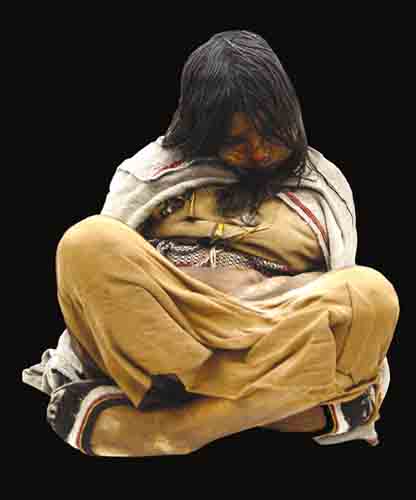
Here is a picture of a 15-year old girl nicknamed La Doncella (the maiden). She was the only mummy on exhibit (the museum rotates them so they aren't all on exhibit at the same time).

The archaeological site where these mummy children were found is the highest altitude site in the world; the children are the best preserved Incan mummies as well. They were frozen- DNA analysis and analysis on their blood and organs has been done.
Though a lot of the information was in Spanish, there were some English translations. It was all very, very fascinating. Visiting the museum was probably my favorite thing we did in the city.
We then went to the city museum; it was a collection of a bunch of random stuff... Amanda wasn't very interested.

This is a picture of one of the cathedrals in Salta. It was built in the 1700s (I think) and was described as the most "outlandish" cathedral in Salta.

We ate at a place across from the cathedral; we tried humita en chala. Humita en chala (en chala meaning wrapped up like this in corn husk) is quite different from a tamale but very good. The masa is wetter- the waiter said it is made with fresh corn, not dried corn masa as used in tamales. It had fresh corn and cheese in the middle; humita is regional food but can also be found in Córdoba (it was really good).

We went back to the hostel relatively early (11:00 ish) because we had to get up way early the next day (6:00 AM). Y'all may not think 6:00 AM is that early but it is when regional custom is to go to dinner around 10:30 PM or later.